

How to Teach Children That Making Mistakes Is Okay
Your child gets one answer wrong on their homework.
The pencil hits the table.
“I can’t do this.”
They draw something that doesn’t look the way they imagined.
The paper gets crumpled.
They miss a goal.
Lose a game.
Forget their lines.
Spill the drink.
Break something accidentally.
And suddenly, what looks like a small mistake to you feels enormous to them.
Some children are naturally more comfortable with mistakes than others. Some become embarrassed, frustrated, or afraid of disappointing the people around them.
As parents and caregivers, we can’t make sure our children always succeed.
And we probably shouldn’t try.
Life will eventually contain wrong answers, awkward moments, poor decisions, rejection, failure, and plans that simply don’t work.
What we can do is help children develop a healthier relationship with those experiences.
Not:
“Mistakes don’t matter.”
Sometimes they do.
But rather:
“Mistakes happen. We can learn from them, fix what we can, and keep going.”
That lesson can serve a child long after the homework is forgotten.
Why Some Children Are So Afraid of Getting Things Wrong
A child who hates making mistakes isn’t necessarily being dramatic.
They may be worried about disappointing you.
They may compare themselves with classmates or siblings.
They may believe being “smart” means always knowing the answer.
They may have been teased after getting something wrong.
They may simply have a temperament that makes mistakes feel especially uncomfortable.
And sometimes adults unintentionally contribute.
We celebrate the perfect score.
Correct every small error.
Jump in before they struggle.
Become visibly frustrated when something spills or breaks.
Compare them with someone who “does it properly.”
Children notice our reactions.
If we want them to believe mistakes are manageable, one of the best places to start is with how our family responds when mistakes actually happen.

1. Change the Way You React to Small Mistakes
A glass of milk spills.
Your child freezes.
Before anything else, pay attention to your first reaction.
Instead of:
“Why are you always so careless?”
try:
“Okay. Let’s get a towel.”
The milk still needs cleaning.
Children still need to learn responsibility.
But an accident doesn’t have to become a judgment about who they are.
The message becomes:
Something went wrong. We deal with it.
That’s a very useful life lesson.
2. Let Them See You Make Mistakes
Adults can look strangely competent from a child’s perspective.
We know how to drive.
Cook.
Use money.
Make appointments.
Find things.
Solve problems.
Children don’t always realize how frequently we’re improvising.
Let them see some of your harmless mistakes.
“Oops. I took the wrong turn.”
“I forgot to buy the eggs.”
“I misunderstood those instructions.”
“I burned dinner.”
Then let them see what happens next.
You turn around.
Add eggs to tomorrow’s list.
Read the instructions again.
Make sandwiches.
Your reaction teaches as much as the mistake.
3. Talk About Your Mistakes Without Attacking Yourself
Imagine dropping something and immediately saying:
“I’m so stupid.”
Your child hears that.
Now imagine they’re the one who drops something.
What might they say to themselves?
Children learn self-talk partly by listening to the adults around them.
Try modeling:
“That didn’t work.”
“I made a mistake.”
“I’ll try another way.”
“I should have handled that differently.”
“I don’t know how to do this yet.”
You’re not pretending mistakes are enjoyable.
You’re demonstrating that making one doesn’t require turning against yourself.
4. Praise the Courage to Try
Children receive plenty of attention for success.
The certificate.
The goal.
The high grade.
The performance.
But what about the child who tried something difficult and didn’t succeed?
Notice that too.
“You were nervous and you still tried.”
“I know that was difficult for you.”
“You didn’t get it this time, but I saw how hard you worked.”
“I’m proud that you gave it a try.”
Children need experiences where effort has value even when there isn’t a trophy attached.
Otherwise, they may learn that the safest way to protect their confidence is to avoid anything they might not be good at.
5. Replace “I Can’t” With “I Can’t Yet”
Your child says:
“I can’t do fractions.”
Instead of immediately replying:
“Yes, you can!”
try:
“You can’t do this part yet. Let’s figure out what you understand and where it gets confusing.”
The word yet isn’t magic.
Some things genuinely take a long time to learn, and everyone has different strengths.
But “yet” leaves the door open.
It changes:
This is something I cannot do
into:
This is something I’m still learning.
That’s a much more useful place to begin.
6. Don’t Correct Everything
Sometimes adults correct children almost automatically.
How they pronounce something.
How they color.
How they fold the towel.
How they arrange something.
How they tell a story.
How they make the bed.
How they complete a project.
Some corrections are necessary.
Others aren’t.
Ask yourself:
Does this actually need correcting?
If your child folds the towel differently but it still fits in the cupboard, maybe the towel can survive.
If their drawing has a purple sun, perhaps astronomy can wait.
Constant correction can make children feel as though they’re always doing something wrong.
Give them room to develop their own ways of doing things when the stakes are low.
7. Ask “What Did You Learn?” Instead of Only “What Went Wrong?”
When something doesn’t work, curiosity can be more useful than criticism.
Ask:
“What do you think happened?”
“What would you try differently next time?”
“Was there anything that worked?”
“What did you learn?”
These questions shift attention from the mistake itself to what comes after it.
Eventually, you want your child’s internal response to failure to become less:
“I’m terrible at this.”
and more:
“Okay. What can I try next?”
8. Don’t Rescue Them From Every Consequence
Some mistakes have natural consequences.
Your child forgets to pack something.
Leaves an assignment until the last minute.
Doesn’t take care of an item and it breaks.
It can be tempting to rescue them every time.
Sometimes intervention is appropriate, especially when consequences would be unsafe or unreasonable.
But when the stakes are manageable, allowing children to experience age-appropriate consequences can help them learn.
Not as punishment.
As information.
“What could help you remember next time?”
Maybe they create a checklist.
Pack their bag the night before.
Set a reminder.
Put something beside the door.
Mistakes become opportunities to build systems rather than evidence that they’re irresponsible forever.
9. Separate the Mistake From the Child
There is an enormous difference between:
“That was a careless choice.”
and
“You’re careless.”
Between:
“You told a lie.”
and
“You’re a liar.”
Between:
“Your room is messy.”
and
“You’re such a messy person.”
Children are still developing.
Try not to turn temporary behavior into permanent identity.
Correct what happened.
Discuss consequences.
Expect accountability.
But leave room for the child to become someone who handles things differently next time.

10. Teach Them That Some Mistakes Need Repair
Teaching children that mistakes are okay does not mean teaching them that mistakes don’t matter.
Sometimes a mistake hurts someone.
They say something cruel.
Break something through carelessness.
Lie.
Ignore an important rule.
In those situations, “everyone makes mistakes” shouldn’t become a way to escape responsibility.
Instead teach:
“You made a mistake. Now what can you do to make it right?”
That might mean:
Apologizing.
Replacing something.
Cleaning up.
Telling the truth.
Trying again.
Accepting a consequence.
Changing their behavior.
Mistakes can be normal while accountability still matters.
That’s an important balance.
11. Share Stories About Times You Failed
Children often know the successful version of their parents.
Tell them some of the less impressive stories too.
The test you failed.
The sport you were terrible at.
The job you didn’t get.
The embarrassing thing you did at school.
The recipe you ruined.
The time you were scared to try something.
Keep the stories age-appropriate, of course.
The point isn’t to turn every dinner into your autobiography.
It’s to help children understand that adults didn’t arrive at adulthood knowing everything.
We learned by getting plenty of things wrong along the way.
12. Don’t Make Perfection the Price of Praise
Sometimes children start believing praise only arrives when something is exceptional.
A 100% grade.
First place.
A spotless room.
Perfect behavior.
Try noticing progress too.
“Your handwriting is getting easier to read.”
“You remembered without me reminding you.”
“You handled that disagreement better than last time.”
“You kept going even after you got frustrated.”
Progress gives children something realistic to aim for.
Perfection gives them somewhere impossible to live.
What If Your Child Gets Very Upset Over Small Mistakes?
Stay calm.
If they’re already overwhelmed, a long lecture about resilience probably won’t help.
Start with the emotion.
“You’re really frustrated because you wanted to get that right.”
Give them time to settle.
Then later, when they’re calmer, talk about what happened.
You can ask:
“What did you tell yourself when you got it wrong?”
Their answer may reveal the real problem.
Maybe they’re thinking:
“Everyone will laugh at me.”
“You’re going to be disappointed.”
“I’m stupid.”
“If I’m not the best, I’m bad at it.”
That’s something you can work with.
What If They Keep Making the Same Mistake?
Accepting mistakes doesn’t mean ignoring patterns.
If your child repeatedly forgets homework, loses belongings, breaks rules, or makes the same harmful choice, they may need more than reassurance.
They may need structure.
Clear expectations.
A routine.
Practice.
Age-appropriate consequences.
Additional support.
You can be compassionate while still saying:
“We’ve talked about this before. Let’s figure out what needs to change.”
Being understanding and expecting improvement can exist at the same time.
Let Them Be a Beginner
Children live in a world where they constantly see people who are already good at things.
Professional athletes.
Musicians.
Artists.
Creators online.
Older siblings.
Talented classmates.
They often don’t see the thousands of unsuccessful attempts that came first.
Remind them:
Everyone starts somewhere.
Let them make the ugly drawing.
Play the wrong note.
Miss the ball.
Mispronounce the word.
Write the messy first draft.
Burn the first pancake.
Fall off the bicycle.
Being bad at something isn’t always evidence that you should stop.
Sometimes it’s simply evidence that you’ve begun.
The Goal Isn’t to Raise a Child Who Loves Failure
Most of us don’t love failing.
Your child probably won’t either.
That’s okay.
You don’t need them to celebrate every wrong answer.
You want them to learn that mistakes aren’t emergencies.
They don’t erase their intelligence.
They don’t remove your love.
They don’t automatically mean they should quit.
Sometimes mistakes contain useful information.
Sometimes they need repair.
Sometimes they’re simply embarrassing.
And sometimes they’re the unavoidable price of learning something new.
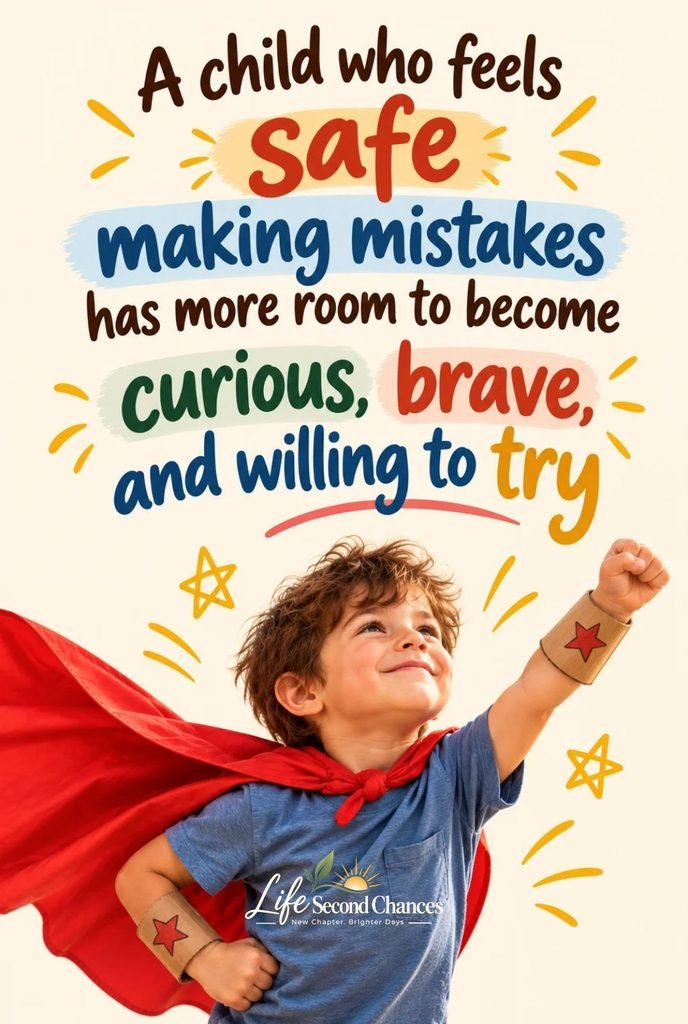
Let Home Be a Safe Place to Get Things Wrong
The world will give your child plenty of feedback.
Grades.
Scores.
Competitions.
Rejections.
Other people’s opinions.
Home can be one of the places where they learn how to process all of that.
A place where a disappointing result can be discussed.
Where mistakes can be admitted.
Where apologies can happen.
Where someone can say:
“I messed up.”
without immediately believing:
“I am a mess.”
One day, your child will face mistakes you cannot help them fix.
By then, you won’t be able to stand beside them for every difficult decision.
But maybe they’ll carry something from all those smaller moments at home.
The spilled drinks.
The wrong answers.
The lost games.
The failed attempts.
The conversations afterward.
And somewhere inside them will be a familiar response:
I got this wrong. What can I learn? What can I repair? And what do I do next?
“A mistake doesn’t have to become a reason to doubt yourself. Sometimes it’s simply where learning begins.”